Gallery


Story
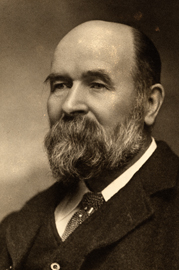
Alexander “Pansy” Morton
(1844 – 1923)
Industrial pioneer, innovator, and creator of the Darvel lace industry
Gowanbank – Home of a Visionary
You are standing at Gowanbank House, once the home of Alexander “Pansy” Morton – the man who transformed Darvel from a quiet weaving village into a world-famous centre of lace and textiles.
From this house, Morton managed a network of factories stretching from Darvel and Carlisle to Donegal, breeding prize horses in the paddocks and growing his beloved pansies in the gardens. Locals affectionately called him “Pansy Morton” for his love of gardening and his prize-winning blooms at the Glasgow Flower Show.
From Humble Beginnings
Born in a weaver’s cottage on Ranoldcoup Road, Darvel, in 1844, Alexander was the son of Gavin (“Guy”) Morton, a weaver and woodsman on the Lanfine Estate. When his father died, six-year-old Alexander had to help support the family.
He worked on local farms from the age of eight, herding cattle on the moors near Muirkirk. These solitary years among the hills gave him a lasting love of nature and animals. At twelve, he returned home to learn the weaving trade, and by fifteen had saved £16 — enough to buy his first loom.
Love and Lace
Through a church singing class, Alexander met Jeanie Wiseman, who became his wife and lifelong partner. They married young and set up home in a small cottage at 104 West Main Street, where Alexander wove lace curtains by hand and began selling them to Glasgow merchants.
In time, he travelled further afield — to Carlisle, Newcastle, and London — personally carrying his samples from shop to shop. He built a reputation for quality, integrity, and innovation, and before long his name was known in the trade.
A Leap into Mechanisation
A visit to the South Kensington Museum in 1874 changed everything. There, Morton saw a mechanical Levers lace machine in operation. Realising that hand-weaving would soon be obsolete, he decided to bring this technology home.
In 1878, with his brother Wee Rab and cousin Big San, he founded A. Morton & Co., erecting a small shed beside the Glen Water powered first by waterwheel and later by steam. The first machine was such a success that more followed quickly. Within ten years, 24 lace machines filled a new factory west of Ranoldcoup Road, and the quiet valley echoed with the hum of industry.
Darvel was transformed. Jobs were created, homes were built, and the town’s reputation for fine lace spread across Britain and beyond.
Expanding a Global Enterprise
Morton continued to experiment — first with hand-woven tapestry, then with chenille and plush curtains, and finally with carpets. He built a new factory in Carlisle, then established a remarkable venture in Killybegs, County Donegal.
There, local women learned to hand-tuft carpets of extraordinary beauty. Soon, Donegal Carpets graced Buckingham Palace, 10 Downing Street, the Houses of Parliament, and even the Royal Yacht. One carpet made for Belfast City Hall measured over 100 feet in length and weighed more than two tons.
Life at Gowanbank
Back home, Gowanbank became both his sanctuary and his workshop of ideas. Morton established a hackney horse stud here, becoming a respected judge at shows in London, Brussels, and New York. His prize stallion Goldfinder — bought for £100 — was later sold for 3,000 guineas.
Among the glasshouses and borders of Gowanbank, he cultivated his pansies — delicate, colourful, and perfectly symmetrical. They became his signature flower and earned him the affectionate nickname “Pansy Morton.”
A Man of Learning and Community
Despite leaving school at nine, Morton never stopped learning. On business trips he carried Burns’ poems and Lyric Gems of Scotland in his case. He had a deep love of art and architecture and visited museums and cathedrals across Europe for inspiration.
He served on Darvel Town Council and as Chairman of the School Board, and he gifted land to the community for what became Morton Park, with the condition that it must remain open ground forever.
His Final Years
In his later years, Morton divided his time between Gowanbank and his fruit farm in Donegal, where he grew apples and kept bees. He and Jeanie celebrated their diamond wedding in 1923, shortly before his death that December.
He was brought home to Darvel and laid to rest in the Old Cemetery on New Year’s Day 1924 — a fitting tribute to a man who had given so much to his town.
The Memorial
Three years later, a memorial was unveiled on the roadside between Darvel and Newmilns, overlooking the valley he transformed. Designed by Sir Robert Lorimer with sculpture by C. Pilkington Jackson, it depicts the old handloom on one side and the modern power loom on the other — symbols of change, creativity, and progress.
Across the top are carved the words: “The wonder of the world, the beauty and the power, the shapes of things, their colours, lights and shades, these I saw: Look ye also while life lasts.”
Beneath his bronze portrait reads: “Alexander Morton, who led this valley to industrial fame and prosperity.”
A Legacy That Lives On
From his first loom in a Darvel cottage to factories that supplied royal palaces, Alexander ‘Pansy’ Morton embodied the best of Scottish ingenuity — a blend of craftsmanship, curiosity, and care for his community.
Here at Gowanbank, surrounded by the gardens he loved, you stand where that story took root — where beauty, industry, and imagination met.
© 2025 Darvel & Area Regeneration Team (DART). All rights reserved. Darvel & Area Regeneration Team is a registered Scottish Charity (SCIO) No. SC050479.