Who knew that Darvel has a Coat of Arms? Granted on 26th Oct 1956 the arms are a heraldic version of the Burgh Seal (Burgh status was granted in 1873). According to Heraldry of the World…
“The arms are a heraldic version of the device on the 1893 Burgh seal. The livery colours appear to have no special significance, the distaff and shuttle represent the weaving industry (mostly lace and madras manufacturing) and the black roundel with its golden estoile a local variety of lamp called a ‘crusie’. The black and silver colours in the chief could also allude to the banner of the Knights Templar.

The Latin motto “Non Sibi Sed Cunctis” means “Not for themselves but for all”
Seems apt for the friendly, supportive and inclusive place that Darvel is today. A motto that will serve the commmunity well through good and hard times.
The RCHAMS (the Royal Commission on the Ancient and Historical Monuments, Scotland) website lists this unhewn olivine monolith as a ‘possible’ standing stone. It is rather curious, and its general size and shape suggest a prehistoric standing stone. It has twelve small connected depressions spread over three of its sides. These have been said to link the stone to astronomical observations and to the noon-day sun height at mid-summer. This would link the stone to life-giving powers, fertility and prosperity. An alternative explanation is that the marks are simply due to weathering over the years.

In 1821 a local blacksmith attached a round sandstone ball to the top of it with an iron bar. Who or why is unknown. It is 1.6m tall and its original position is also unknown. It used to stand in what is now the main street, at the end of Ranoldcoup Road as shown by an old photograph and was moved to the grounds of Brown’s Institute in 1894. From here it was moved to the green at Burn Road in 1938: (recorded by the Ordnance Survey in 1956), and in 1961-2 moved again to its present position in Hastings Square.
The RCHAMS (the Royal Commission on the Ancient and Historical Monuments, Scotland) website lists this unhewn olivine monolith as a ‘possible’ standing stone. It is rather curious, and its general size and shape suggest a prehistoric standing stone. It has twelve small connected depressions spread over three of its sides. These have been said to link the stone to astronomical observations and to the noon-day sun height at mid-summer. This would link the stone to life-giving powers, fertility and prosperity. An alternative explanation is that the marks are simply due to weathering over the years.
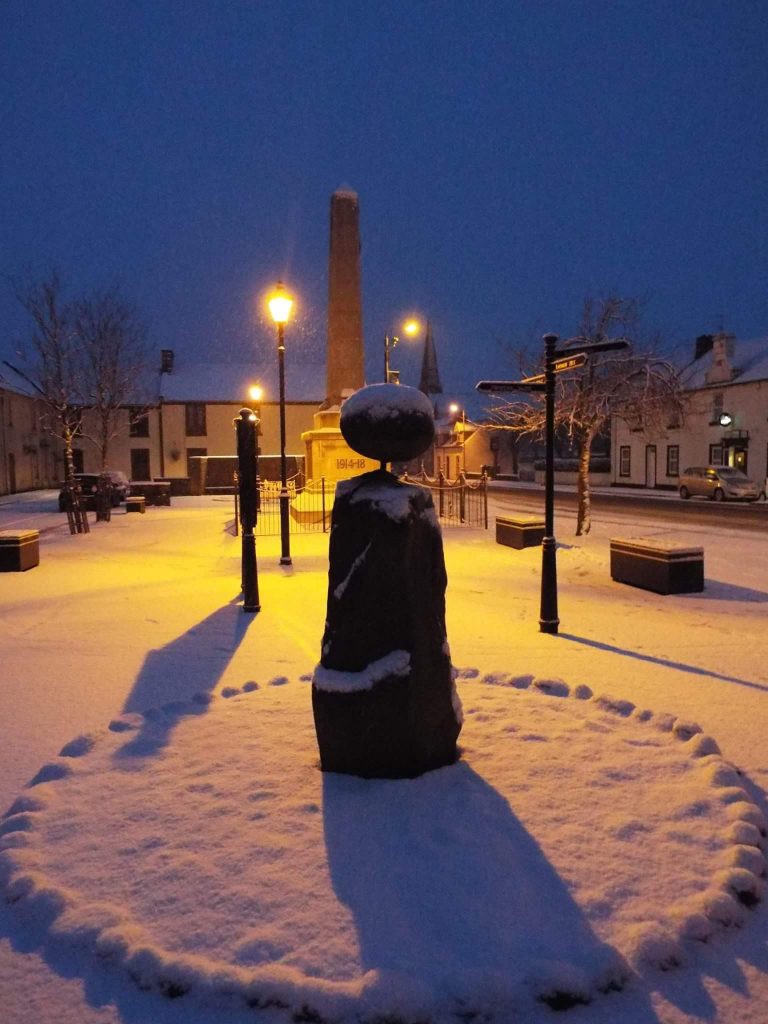
In 1821 a local blacksmith attached a round sandstone ball to the top of it with an iron bar. Who or why is unknown. It is 1.6m tall and its original position is also unknown. It used to stand in what is now the main street, at the end of Ranoldcoup Road as shown by an old photograph and was moved to the grounds of Brown’s Institute in 1894. From here it was moved to the green at Burn Road in 1938: (recorded by the Ordnance Survey in 1956), and in 1961-2 moved again to its present position in Hastings Square.
Author: Stephen A Hunter
Stephen was born in Darvel and lived there [West Main Street] until about 1966 when he sort of moved to Glasgow. “I attended Darvel JS School {Elky Clark} and subsequently went to Kilmarnock Academy. My best memories of both these institutions was the woodwork depts with John Shaw in Darvel and Sonny Jim [George McInnes] in Kilmarnock. At Strathclyde University I studied for Architecture and after a few years I moved with my wife to Dunoon. We then moved to Ardrishaig in 1975 where we have stayed on the banks of the Crinan Canal ever since. My hobby always was woodwork and woodturning. In 2000 I received a grant to carry out research on the Darvel Chairs, one result of which is the article submitted to the Darvel Magazine.”
Until David Jones’ [ of St Andrews University ] article in 95/96 neither I, nor I suspect most other people, knew of the Darvel Chair. I lived in Darvel for the first 25yrs of my life and there was in the kitchen a chair known as the Windsor Chair. As it turned out, it was not a Windsor but one of the chairs of which David Jones had written. It was one of a pair and had been there since the house was built. Also in the family was my great uncle John McNair – the “carrot king” who was born in 1870 and whose father, I subsequently discovered lived adjacent to one of the makers. Nonetheless he knew nothing of the chairs that I can recall. 70 years after it had been made , no one knew anything of its history
Darvel Chairs can be compared to the Windsor Chair in so far as it is constructed on a solid seat base with the turned parts socketed in to it, rather than rectangular sectioned pieces “Jointed” together, by mortice and tenon. But there are differences which I find quite intriguing but whose significance will only be important to “chair geeks” like me.


Back ground
In the Valley there was a long tradition of flax growing much encouraged by legislation after the union of the parliaments in 1704. By the end of the century there were 13 water-powered mills for waulking the flax, grinding corn or sawing timber. Only one water driven mill still remains in the neighbouring village of Newmilns, although place names like Priestland Mill are evidence of other locations. Rankine’s saw mill, originally water powered, existed into 1970 but had long since been converted to electricity
In the 18c. the main industry was weaving which was carried out in a room in the individual weaver’s cottages. As prosperity increased other industries and trades were established. Small communities had to be self – sufficient and skills developed in order that local needs could be satisfied. From the early 1800s whole families of tradesmen arose to form the basis of what was to become generations of skilled workers. Some of these families were still operating 200 years later.
As the population of Darvel and Newmilns was increasing and sustained by the local textile industry, wealth too increased. It is recorded that there were almost 2000 handlooms in these towns. 50 years later the Industrial Revolution hit the area and the first Jacquard power looms were installed. People were therefore able to afford a chair rather than a plain bench.
MAKERS
Four makers have left autographed chairs, John McMath, JK Black, Hugh Shields, and R Mair Very recently the name of D McKellar has been found stamped on a chair. There are obviously other makers and apprentices over the century but their names can only be guessed.
John McMath was born in Darvel in 1797. His father was a cooper [ probably a white cooper making buckets and other ‘staved’ containers] and his grandfather was a wright from the neighbouring village of Galston. This is an old Scottish term for ‘a worker in wood’ or ‘maker’ which gradually went out of use toward the end of the 18C. John McMath lived in West Main Street, and carrying on the family tradition of working in wood, produced chairs, and other pieces of furniture all his life. In the census returns in the later part of the century he calls himself a cabinet- maker. He married twice outliving both his wives. There is no record of him owning a workshop or business and workshop premises were recorded from about 1810. He is buried in Darvel but confusingly a John McMath lived in Biggar and died a year after him.
J.K. Black does not feature in any of the returns in Darvel [from 1840] and as the only chair bearing his stamp is almost identical to an early McMath chair we can only assume he started work with McMath and died or left the area before 1840.
Hugh Shields was an Inn Keeper and Cabinet Maker in Newmilns, the neighbouring village. It was he who having trained with McMath was to be the main follower of the Victorian fashion for ornate mouldings and turnings. In the survey I carried out I came across a chair that was known as ‘Grandfathers Shiellie chair’. The owners did not know why it was so called but it gave me the most original provenance for the chair and the owners were delighted to learn about its maker. [as Hugh Shields made as many chairs as McMath,, if not more there is no real reason why the chairs are not Darvel & Newmilns chairs apart from history]
Hugh Shields has been the subject of some amazing research which I recently was made aware of by Kenny Parker – a descendant – I have suggested to the editor that he contacts him for a wee input. D McKellar as far as I can find out was from Galston , but the similarities to McMath’s chair are such as to convince me that he too was an apprentice.
The last maker yet discovered was R Mair. This is for me quite fascinating as R Mair and Sons were established Joiners from 1810 and functioned up to 2004. Coming from Darvel I new 3 generations of the family. The one nearest my age was a giant of a man with a voice like Paul Robson [ Big John Mair ] . “Mairs” was a joiner / general contractor who built houses, repaired structures installed windows and all the bits and pieces that a local joiner would be expected to do. I do recall when discussing the chairs with John Mair that he had a distant vague memory of having been told that they [ the firm ] had been involved in making them. I was only able to confirm this when I got an e-mail from Georgia from a lady who had a couple of chairs stamped R Mair. Unfortunately Big John Mair died before I could tell him of my find. He would have been so proud.
The significance of Robert Mair and Son being involved is that it provides the premises where McMath worked and the chairs were made. McMath and others would have worked there and made the chairs and other articles of furniture as demand required. It is quite probable that Shields and McKellar travelled up to Darvel on the train as it is only a short journey and walked down Jamieson Road from the station to Robert Mair’s workshop
Before this I was always puzzled as to where McMath worked. There was no evidence of a workshop nor any folk memory regarding him. I discovered he must have been far from wealthy so I would suggest that he was an employee albeit a valued and skillful one, rather than an employer or even self employed.
Finish
I am no expert on Victorian finishes and can only guess that the original finish was a kind of varnish, which has now deteriorated to an extremely dark broken surface. However as the use of ‘shellac’ became more common the Makers obviously saw the advantages of this ‘new’ material which was fairly forgiving to the conditions found in a village workshop . Almost all the mid and late Victorian chairs have been finished in ‘button shellac’ on top of a Brazilwood stain [ in a background of the Victorian love of Mahogany this was an attempt to meet fashion’s demands] the chairs getting a distinctive orange colour. Again I was told by John Mair that his Great Aunt was a “French polisher”
Features
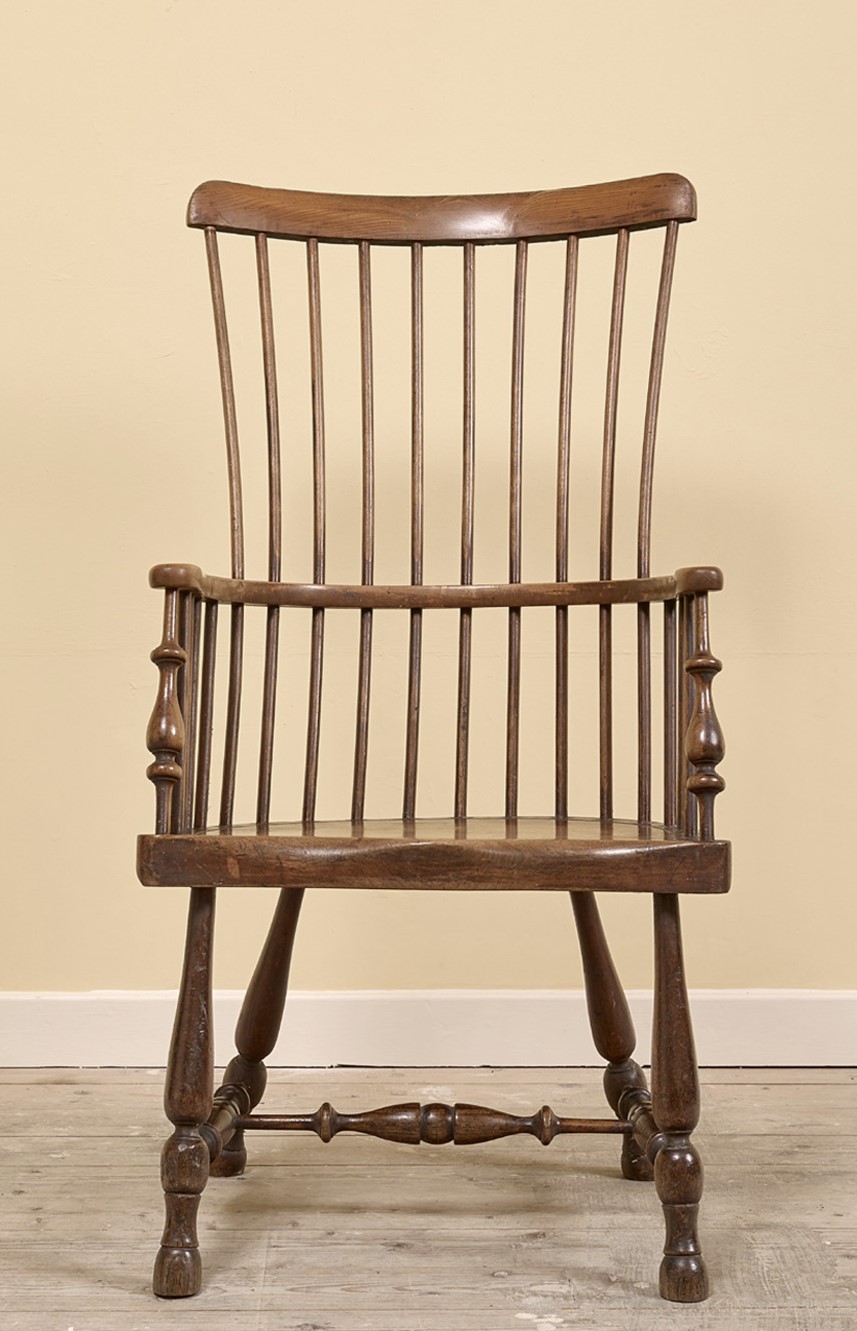

The differentiating features of the Darvel Chairs highlight the difference in technology available between their makers and their counterparts in England.
The arm –bow is made from a naturally curved branch, which is halved, opened out and joined at the back in an excellent scarf joint. Many still retain a little bark. This is similar to boat building technology where curved branches are used to make ‘knees’ and ‘ribs’ Some of the later chairs, mainly by Shields, have arm-bows cut from the solid plank usually of Birch clearly as an attempt to give a uniformity of finish.
The headrest is always sawn out of the solid. This and the way in which the arm-bow was formed suggest that the Makers were not comfortable with steam bending, unlike the Windsor Chair Makers.
The finish at the ends of the arm bow is always the same. From 1786 to 1910 this little finial is used to terminate the arm bow. If you come across a chair with these ends to the arm bow – it is likely to be a Darvel chair.
It is also an interesting feature that the back spindles or spars are the same diameter and I would claim were made with the same rounding plane. The odd size of 9/16 is far from standard and of course a drill bit of a corresponding size would be needed. I have made several of these rounding planes and can vouch for their temperamental ‘attitude’. It is not impossible that this valuable tool was McMath’s father’s or even grandfather and handed down through the generations and was even handed over to Shields on McMath’s death.
The obvious distinctive feature is of course the rake of the whole chair. The seat is sloped down towards the back and the back comb has this very steep slope.
The Windsor chairs of England are much more upright and as a result appear more formal. The Darvel chair is a very ergonomically successful piece of furniture.
The curious fact remains that despite the importance of this industry, the names of the wrights are not common knowledge, no mill remains, no memory exists in the villages of them or their work. Nothing is written of them, and they made small impact even though their output must have been considerable. I can only speculate on the reason for this.
It was as if the community had dismissed the significance of these men and their work in the typical Scottish way of ‘oh him, I kent his faither’ and so failed to appreciate what they had done. Instead of taking a pride in their achievement -they were forgotten. The only evidence that can be found are the chairs themselves.
The number of chairs made over the years is open to conjecture, but a survey I carried out showed more than one hundred chairs still remain. Many must have been destroyed in the intervening hundred years. It is not unreasonable to guess that several hundred were made. The community supported the makers and the chairs were bought by mill owners and farmers, ministers and the common populace, often in pairs. Those that remain are jealously guarded family heirlooms. I have traced them all over the UK, Massachusetts, Georgia, Canada and New Zealand.
If you have a chair or know of one I will be pleased to hear from you.
Author: Frank Donnelly
Lochfield Farm lies four miles north of Darvel. Extending to some 800 acres, its boundary forms part of the division between Ayrshire and Lanarkshire. To the north is the Whitelee Forest Wind Farm, to the west, the Glen Water. The road to Lochfield extends for over a mile off the “Five Mile Road” from Darvel.

It was here, on 6th August 1881 that Alexander Fleming was born. He was the seventh child of a family of eight. From his earliest years he grew to know the countryside and its wild life as few town dwellers could ever hope to do. The Fleming children found their amusements in guddling trout in the burns, trapping rabbits in the hills, searching for birds’ nests and seeing nature change from season to season.
When he was five Alex began his formal schooling at Loudoun Overmoor School House, about a mile from Lochfield on the “Five Mile Road”. There were rarely more than a dozen pupils of ages ranging from five to ten years at this one room and one teacher school. There were no examinations and only the occasional visit of an inspector. Modern educationists might shudder at such conditions, but Fleming asserted that he received the best part of his education at this little school.
Later, Alec attended Darvel School. Each day he had to walk the four miles from Lochfield to the school and back. With growing perception he learned much from his daily walk over the hills, which incidentally built up in him such stamina and endurance that in adult years he was a man who rarely knew fatigue. For a time he attended Kilmarnock Academy before leaving for London to join his brother Tom, an optician, who eventually practised in Harley Street. In London, Alex resumed his studies at Regent Street Polytechnic, but found that he was two years in advance of the standards there. Leaving school at sixteen he made a brief sojourn in commerce as junior clerk in a shipping office, but soon gave this up to enter a medical career as a student in St. Mary’s Hospital. In 1902 he sat a scholarship examination and gained first place competing against the top brains of the country. Indeed he was awarded first place in every examination he took throughout his career. He was a brilliant student, for his was a keenly incisive intelligence which could cut through a mass of information to sift out and retain only the relevant parts.
In 1906 he passed the L.R.C.P examination and was offered a temporary junior post in the laboratory of the great bacteriologist, Almroth Wright. This he accepted, little dreaming that it would be here that he would work for most of the rest of his life, and here that he would make one of the greatest discoveries in medical history.

The work in Wright’s laboratory suited him and soon became his main enthusiasm. In those days the work of the laboratory was mainly directed to exploring the development of curing diseases by inoculation. It was not long before Fleming, with the publication of his papers on a variety of subjects, began to be noticed, not merely as one of Wright’s assistants, but as a bacteriologist in his own right. During World War 1, Fleming continued his research work as a Captain in the Medical Corps carrying out autopsies on dead soldiers many of whom died from septicaemia caused by open wounds being infected by the mud of the battlefields in Flanders.
After the War ended Fleming was responsible for the discovery in 1922 of Lysozyme, an antiseptic which improved greatly the healing of wounds after operations. Then in 1928, while he was experimenting in the laboratory, a stray spore of a mould found its way on to a culture plate which he was using. His mind, conditioned by those earlier experiments, noticed the unusual effects of the mould spores on the bacteria on the Petry dish. Fleming acted at once and managed to preserve a minute specimen of the mould. He used a crude culture of extract from the mould on various bacteria with startling results. The mould was later recognised as one of the rarer members of the Penicillia group, Penicillium Notatum. Fleming gave it the name penicillin.
Thus penicillin, in its crude form, was discovered in 1928, but it was not until the 1940s that the world at large learned of it. During the intervening years work went ahead, despite many setbacks, to produce penicillin sufficiently pure and in sufficient quantity to use on human beings. This was ultimately achieved by a team of Oxford scientists headed by Dr. Howard Florey and Dr Ernst Chain. It was the Second World War which led to the mass production of penicillin as the world’s best antibiotic, and 646 billion units of the drug were produced in the War years to save countless numbers of lives. The American Army took 2.3 million dozes of penicillin with them for the D-Day landings in Normandy in 1944.
Fleming did not take out a patent on his wonder drug, and he gained no royalties for it, but the world was not slow to shower him with honours, honorary degrees, statues and public acclaim throughout the 1940s. He was knighted in 1944, won the Nobel Prize for Science in 1945 and insisted that this award should be shared with Florey and Chain, and he became the first Freeman of the Burgh of Darvel in 1946, an award of which he was very proud. From then on Sir Alexander became a world ambassador for his profession, meeting top politicians, presidents, kings in all major countries, but he still kept contact with Darvel as he had bought his old schoolhouse as a holiday home to escape the paparazzi, and he visited it fairly frequently.

Eventually the strain of his public life caught up with him and on 11th March 1955 Sir Alexander died of a heart attack. His ashes are buried in the crypt of St Paul’s Cathedral under a flagstone with the letters “A.F.” on it. Sir Alexander Fleming is not just a local hero but an international hero. It is calculated that his wonder drug has saved in excess of 200,000,000 lives worldwide. Most of us have been given penicillin in some shape or form during our lives, life expectancy has increased dramatically due to the discovery of penicillin, and the world at large has much to be thankful for in the life and work of this modest genius who was a Darvel man.